

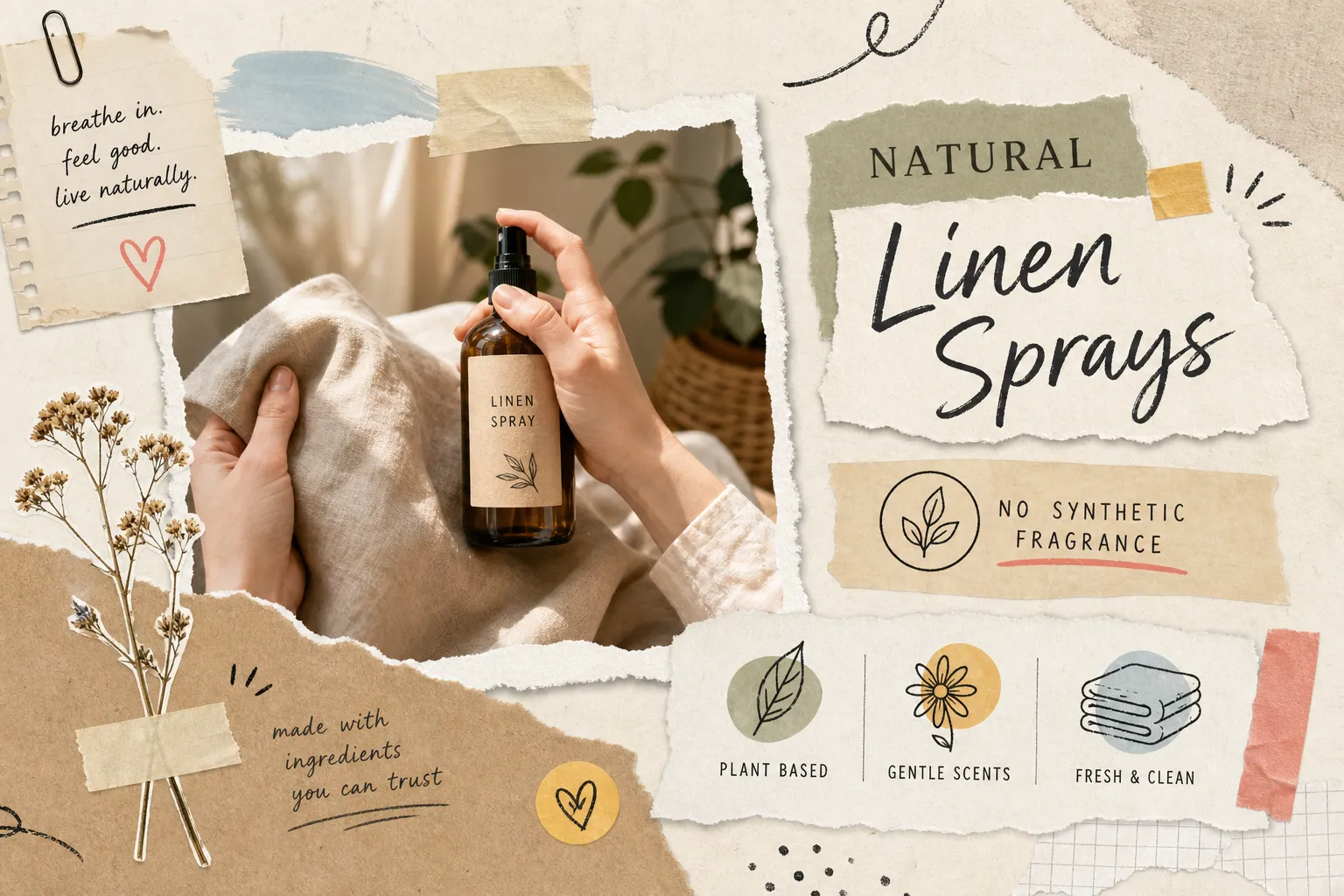
You pick up a bottle at the store. It says "naturally scented" right there on the front, in soft green lettering, next to a little lavender sprig illustration. You flip it over, find the ingredient list, scan down, and there it is. One word: fragrance. No breakdown. No details. Just that single, tidy, legally protected word sitting there doing the work of possibly hundreds of undisclosed synthetic aroma chemicals. And the bottle still gets to call itself natural.
If you've ever wondered what is the best natural linen spray without synthetic fragrance, you're asking exactly the right question, because not everything marketed as natural actually qualifies. This happens more than most people realize, especially in the linen spray category, where marketing language like "plant-inspired," "botanical," and "nature-fresh" creates a convincing enough impression that shoppers rarely think to dig deeper. This guide gives you the tools to do just that and to shop (or DIY) with genuine confidence. We'll cover what makes an essential oil linen spray truly clean, which label terms to treat as red flags, what fabric safety looks like in practice, and which brands actually show you every ingredient without hiding anything behind a catch-all term.
Why "Natural" on a Linen Spray Label Doesn't Always Mean What You Think
Here's the uncomfortable truth: "natural," "plant-based," and "nature-inspired" are marketing phrases, not regulated claims. Under U.S. law, a manufacturer can put all three on the front of a bottle while still using synthetic aroma chemicals in the formula. The label isn't lying, technically. It's just not telling you the whole story.
The Fragrance Loophole That Gives Brands Legal Cover
"Fragrance" and "parfum" are umbrella terms. A manufacturer can list a complex cocktail of synthetic aroma compounds, fixatives, and stabilizers under either of those single words without disclosing what's actually inside. This is why two sprays can both say "lavender-scented", one using real lavender essential oil, one using a synthetic aroma chemical engineered to smell like lavender, and neither label is technically incorrect. The difference between them is real, but the label won't always tell you which is which.
Why This Matters Even More for Your Bedroom
Bedding is in contact with your skin for seven or eight hours a night. That's a different exposure profile than, say, a scented candle you walk past in the living room. Synthetic fragrance chemicals linked to skin irritation, allergic reactions, and hormone disruption have more opportunity to affect you on a pillowcase than almost anywhere else in your home. If you or someone in your household deals with sensitivity, eczema, or asthma, the linen spray you choose for the bedroom is worth examining closely.
How to Read a Linen Spray Label Like Someone Who Knows What They're Looking For
Good news: this skill takes about five minutes to learn and pays off every time you shop. The core principle is simple. A product that names every aromatic ingredient individually (e.g., "lavandula angustifolia essential oil," "chamomile essential oil") is more trustworthy than one that bundles everything under a catch-all term.
Red Flag Terms That Signal Synthetic Fragrance
Train yourself to pause when you see any of the following on an ingredient panel:
- "Fragrance," "parfum," "perfume," "aroma," or "aromatic blend"
- "Natural fragrance" or "botanical fragrance", these phrases still don't guarantee full ingredient disclosure
- Synthetic musks by name: galaxolide, tonalide, HHCB, AHTN
- "Odor neutralizer," "scent enhancer," or "masking fragrance"
- Diethyl phthalate (DEP), a fixative that sometimes appears in fragrance formulas
A "phthalate-free" claim is worth something, but don't stop there. A spray can be phthalate-free and still contain a dozen other undisclosed synthetic aroma chemicals. You want to see named essential oils, not a clean-sounding promise with a loophole underneath it.
Certifications That Actually Carry Weight
COSMOS Organic and COSMOS Natural are the most meaningful third-party verifications for finished household spray products. Both prohibit synthetic fragrance in the certified formula; the key is verifying that the finished product is certified, not just that an ingredient supplier holds a COSMOS certificate. "EWG Verified," "USDA Organic," "clean," and "plant-based" sound credible but don't specifically restrict synthetic fragrance in a household spray context. They're starting points, not finish lines.
What Is the Best Natural Linen Spray Without Synthetic Fragrance? Our Top Picks
There's a meaningful difference between a brand that says it's natural and a brand that shows you exactly what's inside. The following options have earned their place on this list by doing the latter, publishing every ingredient clearly so you know precisely what you're spraying on the fabric your skin will rest against all night.
Best of Nature: The Brand That Actually Shows You What's Inside
Best of Nature, a small-batch wellness brand handcrafted in New Jersey, stands out in this category, not just because of what's in their sprays, but because of what isn't. Their linen and room sprays are made with 100% pure essential oils: no synthetic fragrance, no "parfum," no filler aroma chemicals, no mystery. The ingredient list reads like something you'd recognize, water, essential oil(s), natural alcohol. That's it. No decoding required.
The brand offers multiple essential oil blends, including lavender, eucalyptus, and calming combinations, and maintains the same transparency across their entire line. Their products are trusted and regularly reordered by licensed massage therapists who have the professional experience to know the difference between genuinely clean and convincingly greenwashed. Best of Nature also uses these products with their own families, which reflects real confidence in the formulas. If a brand can't label a clean, essential-oil-based linen spray as clearly as Best of Nature does, that's worth noting before you buy.
Other Options That Meet the Transparency Standard
A few other brands publish ingredient panels that name their aromatic components individually rather than hiding them under "fragrance." Victoria's Lavender Linen Spray lists pure lavender essential oil as its scented ingredient and is positioned as an aromatherapy bedding spray. DRMTLGY Natural Lavender Linen Mist lists lavender essential oil, chamomile, witch hazel, and jojoba oil. Calm Aromatherapy Mist uses witch hazel plus lavender and chamomile essential oils. Carroll and Chan is worth considering for users who prioritize scent longevity; customer reviewers have reported that their botanical oil formula stays noticeable on sheets for several days, with a fine mist that avoids spotting. Always re-check current labels before purchasing, since formulas can change even when a brand's positioning doesn't.
How to Choose the Best Natural Linen Spray Without Synthetic Fragrance
Knowing which questions to ask makes all the difference. Whether you're comparing an organic linen spray to a fragrance-free linen spray, or weighing a DIY batch against a ready-made bottle, a few practical filters will steer you toward genuinely clean options every time.
Why Pure Essential Oil Formulas Are Genuinely Better for Bedding
A plant-based room spray built on pure essential oils isn't just a safer option in theory, it delivers something synthetic versions can only approximate. Lavender essential oil contains linalool and linalyl acetate in naturally occurring ratios, alongside dozens of minor aromatic compounds that contribute to its character. A synthetic lavender fragrance oil is engineered to smell like lavender; it's not the same thing, even when it smells convincingly similar. For readers who use a clean-label linen spray as part of a wind-down ritual before sleep, that distinction is real. Full ingredient transparency is also its own form of peace of mind, you know exactly what you're misting onto the fabric your face will rest on tonight.
How Essential Oil Sprays Perform Differently on Fabric
Being honest here serves you better than overselling. Pure essential oil sprays on cotton typically evaporate in roughly 30 minutes to a couple of hours, depending on the oils used and the formula's carrier. Synthetic fragrance sprays often last longer because they're built with fixatives designed to extend scent persistence. That's a real trade-off. The practical workaround is simple: spray your bedding right before you settle in, so you get the full benefit of the scent while it's still present. Heavier essential oils like cedarwood, sandalwood, and bergamot naturally linger longer than citrus or eucalyptus, so your oil choice matters too.
Fabric Safety and Allergy Precautions Before You Start Spraying
Even a genuinely clean formula needs to be used thoughtfully. "Natural" doesn't automatically mean safe for every fabric, every person, or every household situation.
Which Fabrics Need a Patch Test First
Before spraying any linen mist on a fabric you care about, test a hidden area and wait 24 hours. Fabrics that deserve extra caution include silk, velvet, wool, acetate, satin, and anything dark-dyed, coated, or labeled dry-clean only. Water-based sprays can cause rings on these materials even without oil residue. For everyday cotton and linen, a patch test is still smart practice. Spray from about 12 inches away, keep the mist light, and let fabric dry completely before contact with skin.
Precautions for Sensitive Individuals, Pets, and Kids
Essential oils are natural, but they're also potent. They can trigger reactions in people with fragrance sensitivity, asthma, or known allergies to specific plant compounds. Ventilate the room after spraying, never spray directly onto a pillow while someone is sleeping on it, and keep linen sprays stored away from pets and small children. If someone in your household has asthma or a confirmed fragrance sensitivity, start with the lightest possible concentration and consider whether a truly unscented, fragrance-free linen spray might be the better fit.
How to Make a Safe DIY Linen Spray If You'd Rather Skip the Shopping
Making your own essential oil linen spray isn't complicated, but the details matter. A few shortcuts commonly shared online actually create problems, mostly staining and oil spots, that are easy to avoid with the right approach.
A Simple Ratio That Works Without Staining Your Sheets
For an 8 fl oz (240 mL) batch, follow these steps:
- Start with distilled water as your base.
- Measure out 5 to 10 drops of essential oil (a 0.25 to 0.5% concentration, which is the right range for fabric that touches skin).
- Add an equal amount of Polysorbate 20 to your essential oil and combine those two ingredients first. This step is critical, essential oil and water don't mix on their own, no matter how vigorously you shake the bottle. Without a solubilizer, the oil floats and lands in droplets on your fabric, leaving spots.
- Add the pre-mixed oil and solubilizer to your water. A small splash of high-proof vodka can also help with dispersion and speed up drying time.
Good essential oil choices for a bedroom spray include lavender, chamomile, bergamot, cedarwood, and eucalyptus. Best of Nature's single essential oils are an excellent source for DIY blends because they're 100% pure with no synthetic carrier added, exactly what you want when you're controlling the formula yourself.
Storage and Flammability Reminders
If your recipe includes alcohol, treat the finished spray as flammable. Keep it away from candles, open flames, and heat sources. Never spray it onto hot laundry or near dryer vents. Make small batches, label and date the bottle clearly (something like "linen spray, not for skin"), and discard it if the scent or appearance changes. Store in a cool, dark place and keep the cap tight between uses.
The Ingredient List Tells the Real Story
So what is the best natural linen spray without synthetic fragrance? The answer starts with the ingredient list, specifically, whether the brand names every scented component individually or hides them behind a single, legally convenient word. The word "natural" on a label is a starting point, not a guarantee.
When you see "lavender essential oil, chamomile essential oil" on a label instead of just "fragrance," that's a brand being honest with you. That's the standard Best of Nature holds itself to across their entire product line. Their linen and room sprays read like a recipe you'd recognize, made by people who care enough to show you exactly what's inside and why. Browse their linen and room spray collection to see what transparent labeling looks like in practice.
You don't need a chemistry degree to find the best natural linen spray without synthetic fragrance. You just need to know what to look for, and now you do.
Frequently Asked Questions
What is the best natural linen spray without synthetic fragrance?
The best option is any spray that lists every scented ingredient by name, typically pure essential oils, rather than using catch-all terms like "fragrance" or "parfum." Best of Nature's linen and room sprays are a strong example: they use 100% pure essential oils with no synthetic fragrance, no fillers, and no hidden aroma chemicals. For a broader search, look for COSMOS-certified organic linen sprays or brands that publish a complete ingredient panel.
Is "natural fragrance" the same as an essential oil?
No. "Natural fragrance" is still an umbrella term that does not require full ingredient disclosure. A brand using this label may be using isolated aroma chemicals derived from natural sources rather than whole essential oils. Always look for products that name the specific essential oil (e.g., "lavandula angustifolia oil") rather than grouping ingredients under any fragrance term.
Can I use an organic linen spray on all fabrics?
Not without checking first. Even a genuinely clean, organic linen spray can cause water rings or discoloration on delicate materials like silk, velvet, satin, and wool. Always patch-test a hidden area and wait 24 hours before applying to any fabric you're not willing to risk.
How long does a natural essential oil linen spray last on sheets?
Pure essential oil formulas typically evaporate within 30 minutes to a few hours on cotton, which is shorter than synthetic fragrance sprays that use fixatives. For best results, spray your bedding right before you get in, and choose heavier base-note oils like cedarwood or sandalwood if you want the scent to linger longer.

